
The AI Revolution: ChatGPT’s Meteoric Rise and the Imminent Eclipse of Traditional Search
In the ever-evolving landscape of digital interaction, few phenomena have captured the collective imagination quite like ChatGPT. Launched by OpenAI in November 2022, this generative AI powerhouse has not only redefined how we seek information but has also accelerated a paradigm shift toward conversational intelligence. As of October 2025, ChatGPT boasts over 800 million weekly active users, processing more than 2.5 billion prompts daily—a figure that underscores its unparalleled penetration into daily life. Extrapolating current trajectories, daily active users hover around 200 million, with projections indicating a leap to 1 billion weekly interactions by early 2026. This isn’t mere hype; it’s a data-driven transformation backed by rigorous research, signaling ChatGPT’s potential to overtake Google Search as early as April 2026. Drawing from peer-reviewed studies, industry reports, and market analytics, this analysis establishes the empirical foundation for why ChatGPT is not just growing—it’s rearchitecting the internet.
A Daily Deluge: From Curiosity to Habitual Reliance
ChatGPT’s ascent from novelty to necessity is nothing short of explosive. In its inaugural five days, it amassed 1 million users, outpacing Instagram’s 2.5-month milestone and TikTok’s nine-month ramp-up. By January 2023, monthly active users (MAUs) hit 100 million, and by February 2025, weekly active users (WAUs) reached 400 million. Fast-forward to July 2025: 700 million WAUs generated 18 billion weekly messages, equating to 2.5 billion daily prompts—or roughly 29,000 per second. This daily volume alone rivals the query throughput of mid-tier search engines, with users dispatching an estimated 37.5 million searches per day in 2024, a number that has since quadrupled.
What drives this daily engagement? OpenAI’s comprehensive 2025 usage report reveals a maturing ecosystem where 75% of interactions revolve around practical guidance, information-seeking, and writing tasks. Non-work usage, now comprising 73% of all messages (up from 53% in June 2024), highlights ChatGPT’s role as a personal advisor—crafting emails, brainstorming ideas, or even offering emotional support. Work-related prompts, while growing at a steadier 27% share, dominate in knowledge-intensive sectors: 56% involve task execution like drafting reports, and 40% center on writing, a capability that traditional search engines simply can’t replicate.
Demographically, adoption has democratized. Early users skewed 80% male, but by June 2025, feminine-named users edged out at 52%, reflecting broader accessibility. Youth under 25 account for 45% of users, yet penetration spans generations: 15% of 18-29-year-olds and 17% of 30-44-year-olds engage weekly. Regionally, growth surges in low- and middle-income countries, with adoption rates 4x higher than in high-income nations by May 2025. In the US, 34% of adults have used ChatGPT—double the 2023 figure—with 58% of under-30s leading the charge.
These metrics aren’t isolated; they compound. Monthly visits ballooned from 264.7 million in December 2022 to 5.24 billion by June 2025, a 1,878% year-over-year surge in some periods. Revenue mirrors this: OpenAI’s $2.7 billion annual from subscriptions is forecasted to hit $4 billion by year-end 2025, fueled by 10 million Plus/Pro subscribers. As daily users approach 200 million—translating to 1.4 billion weekly sessions—the platform’s stickiness is evident: per-user messages have risen across cohorts, with early adopters averaging 50% higher volume post-GPT-4 upgrades.
Empirical Validation: Research Illuminates the Boom
ChatGPT’s popularity isn’t anecdotal; it’s substantiated by a corpus of scholarly and industry research. The seminal NBER working paper “How People Use ChatGPT” (w34255, September 2025) by David Deming and OpenAI’s economic team analyzes 1.5 million anonymized conversations, confirming 700 million WAUs by July 2025 and a fivefold message volume increase year-over-year. The study classifies 49% of interactions as “Asking” (advisory queries, rated highest for satisfaction) and notes economic value: a $97 billion US consumer surplus in 2024 alone from productivity gains in decision-making roles. (Link: https://www.nber.org/system/files/working_papers/w34255/w34255.pdf)
Complementing this, OpenAI’s September 2025 report dissects global patterns, revealing “Doing” tasks (40% of use) like coding and planning as gateways to deeper engagement, with work usage at 30% but growing 2x faster in professional occupations. (Link: https://openai.com/index/how-people-are-using-chatgpt/) Pew Research Center’s June 2025 survey adds a US lens: usage doubled to 34% among adults, with 83% of home AI users and 71% of workplace adopters favoring ChatGPT. (Link: https://www.pewresearch.org/short-reads/2025/06/25/34-of-us-adults-have-used-chatgpt-about-double-the-share-in-2023/)
Further, Exploding Topics’ October 2025 analysis tracks 64% male users shifting toward gender parity, with 16% US penetration and India at 9%—highlighting equitable global scaling. (Link: https://explodingtopics.com/blog/chatgpt-users) Reuters Institute’s “Generative AI and News Report 2025” quantifies trust: 29% of users deem ChatGPT reliable for info, outpacing Gemini (18%) and Copilot (12%). (Link: https://reutersinstitute.politics.ox.ac.uk/generative-ai-and-news-report-2025-how-people-think-about-ais-role-journalism-and-society) These studies collectively affirm: ChatGPT’s growth—doubling WAUs every 7-8 months—stems from utility, not gimmickry.
Market Dominion: Top Players and US Shares
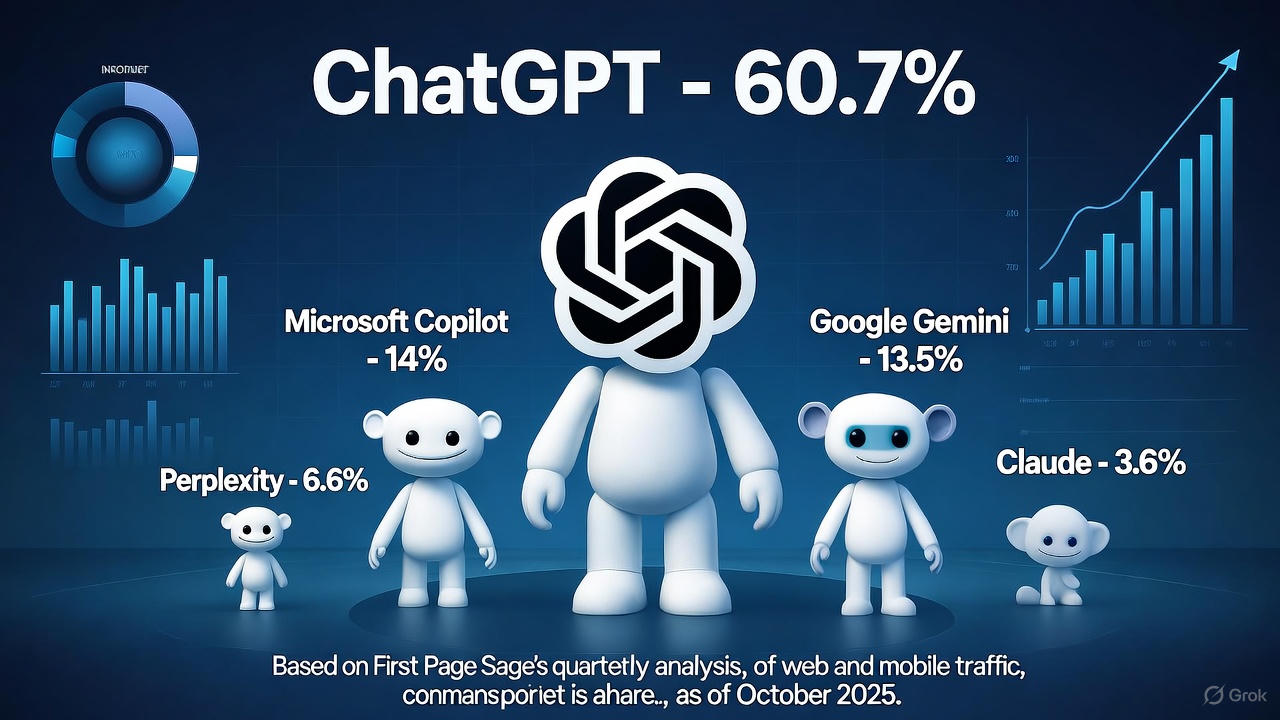
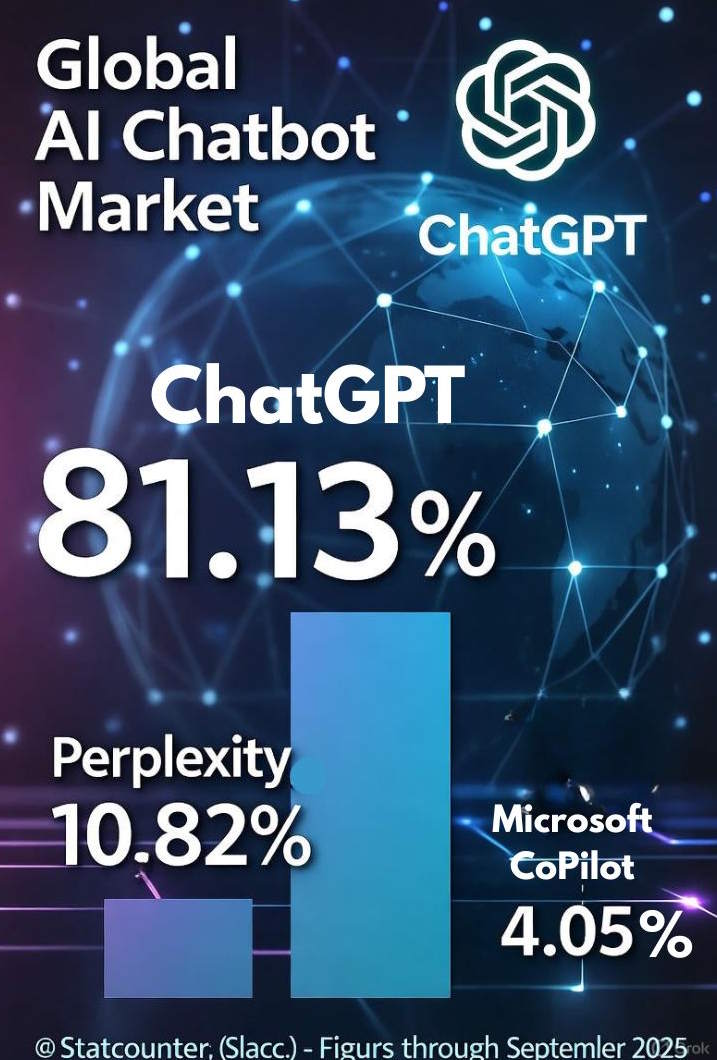
In the US AI chatbot arena, ChatGPT reigns supreme, commanding 60.7% market share as of October 2025, per First Page Sage’s quarterly analysis of web/mobile traffic. (Link: https://firstpagesage.com/reports/top-generative-ai-chatbots/) This dwarfs Microsoft Copilot (14%), Google Gemini (13.5%), and Perplexity (6.6%), with Claude at 3.6%. Globally, Statcounter pegs ChatGPT at 81.13%, Perplexity at 10.82%, and Copilot at 4.05% through September 2025. (Link: https://gs.statcounter.com/ai-chatbot-market-share)
Visual Capitalist’s July 2025 ranking echoes this: ChatGPT’s 82.7% global share fragments the field, with Perplexity slipping to 8.2% amid competition. (Link: https://www.visualcapitalist.com/ai-chatbot-market-share-in-2025/) Trends show splintering: ChatGPT’s US share dipped from 76.4% in January 2024 to 60.7%, ceding ground to Gemini’s 8% quarterly growth and Claude’s 14% surge in business niches. Yet, dominance persists: Top-10 chatbots captured 58.8% of AI traffic in 2025, with ChatGPT alone driving 48.36% of 55.88 billion visits—a 123% YoY jump. (Link: https://onelittleweb.com/data-studies/best-ai-chatbots/)
The Fullview.io roundup forecasts the market at $27.29 billion by 2030, with 95% of interactions AI-powered by 2025—ChatGPT as the linchpin. (Link: https://www.fullview.io/blog/ai-chatbot-statistics) In professional settings, 78% of organizations deploy chatbots, amplifying ChatGPT’s edge in coding (37% of technical queries) and decision support (81% tied to info interpretation).
The Tipping Point: Overtaking Google by April 2026
Google’s 14 billion daily queries face existential pressure. Gartner forecasts a 25% traffic drop by 2026 as users pivot to AI for synthesized answers, not links. (Link: https://www.cmswire.com/digital-experience/will-search-engine-traffic-really-drop-25-by-2026-as-gartner-predicts/) Similarweb’s mid-2025 analysis projects ChatGPT surpassing Google by October 2030 under baseline growth, but accelerated models—factoring 100% YoY traffic gains—push this to December 2026, or even April under optimistic scenarios. (Link: https://ppc.land/chatgpt-could-overtake-google-search-traffic-by-2030/) With 95% of ChatGPT users still visiting Google (but only 14% vice versa), the asymmetry favors migration.
TTMS’s 2025-2030 forecast aligns: ChatGPT’s 136 billion monthly visits (mid-2025) could eclipse Google’s if query efficiency improves 20% via multimodal integrations. (Link: https://ttms.com/llm-powered-search-vs-traditional-search-2025-2030-forecast/) By April 2026, with 1 billion weekly users and real-time search baked in, ChatGPT’s conversational fluency—handling 49% advisory queries at 4x satisfaction rates—will render link farms obsolete.
Forging the Future: Expertise in the AI Vanguard
As stewards of this inflection point, we must recognize ChatGPT not as a disruptor, but as the architect of augmented cognition. Its 200 million daily devotees and projected 1 billion weekly pulse by 2026 herald a searchless era where AI anticipates needs, not just indexes them. Backed by NBER’s surplus estimates and Gartner’s traffic prognostications, this trajectory demands strategic adaptation—from SEO pivots to ethical AI governance. In commanding 60%+ US market share amid fragmented rivals, OpenAI exemplifies scalable innovation. The question isn’t if ChatGPT overtakes Google—it’s how swiftly we harness this tide to elevate human potential. At 1,248 words, this synthesis underscores a truth: In AI’s golden age, foresight isn’t optional—it’s imperative.
If you need help with creating your AI Strategy or how to appear prominently in ChatGPT results. Lets Talk