
The Big Squeeze: How New Yorkers Got Priced Out and What Zohran Mamdani Plans to Do About it
Affordability, Consumerism vs. Sustainability
Let’s be real. If you’ve lived in New York City for more than a minute, you’ve developed a sixth sense. It’s not just for spotting a rat on the subway tracks or knowing which bodega has the best chopped cheese. It’s the calculus of survival. You’re not just counting dollars; you’re constantly triangulating the cost of the (soon to be retired) MetroCard, a bodega sandwich, and the ever-looming specter of the rent. There’s a low-grade panic humming in your bones, a financial Spidey-sense that tingles every time you swipe your card. This feeling? It’s not new. But over the last twenty years, that gentle, nagging creep of prices has turned into a full-blown mugging in broad daylight. We’re all getting squeezed, and frankly, we’re running out of breath. The gentle upward creep of prices has transformed into a relentless vice grip, squeezing the middle class, the working poor, and frankly, anyone who isn’t a billionaire.
From the bodega counter to the ballot box, the story of modern life in America is a story of affordability—or the crushing lack thereof. And for New Yorkers, the canaries in this national coal mine, this crisis found its most potent voice in a political movement led by figures like Zohran Mamdani, who won the mayor’s office by speaking a single, undeniable truth: we are being priced out of our own lives. This is the story of how the dream of an affordable New York life was dismantled, piece by piece, from the global stage down to your breakfast plate.
Remember When the Internet Was a Line Item, Not a Kidney?
Let’s take a trip down a memory lane paved with, if not gold, then at least reasonably priced concrete. Around the turn of the millennium, a New Yorker could cobble together a basic existence without needing a six-figure salary. I need to take you back to my first Astoria apartment. A fourth-floor walk-up with a fire escape that doubled as my “patio” for growing remarkably resilient basil. Setting up the utilities felt… manageable. Then the internet bill came. It was from some company I’d never heard of, their logo a pixelated blob on a CD-ROM they mailed me. The damage? $14.99 a month. I paid it without a second thought. It was the cost of two movie rentals and a Blockbuster late fee.
Fast forward to today. That same essential utility—now the absolute lifeblood of work, school, and my social life—is a line item that requires a payment plan. I’m currently staring at a bill from my only viable provider, Verizon Fios (because its fast & reliable with almost no downtime or outages) for **$79.99**. Why? It’s not because the data is made of gold. It’s because I have all the choice of a prisoner in a cell. A **2020 report from the Institute for Local Self-Reliance** confirmed what I feel in my bones: nearly 83 million of us are living under a broadband monopoly. They’re not companies; they’re feudal lords, and we’re just serfs paying for the privilege of being connected. Is that a bit dramatic? Maybe. It depends who you ask. It also depends where the person lives. The city of new york is cut into different zones which have artificial barriers. Think of it like gang land where certain zip codes are Spectrum Land, and certain zip codes are Comcast, and others are Optimum or Altice (as its now known as) and in some rare instances, like where I presently live in the Bronx, I the customer actually have a choice between Optimum or Verizon, and now, T-mobile Home Wireless or AT&T Home Wireless.
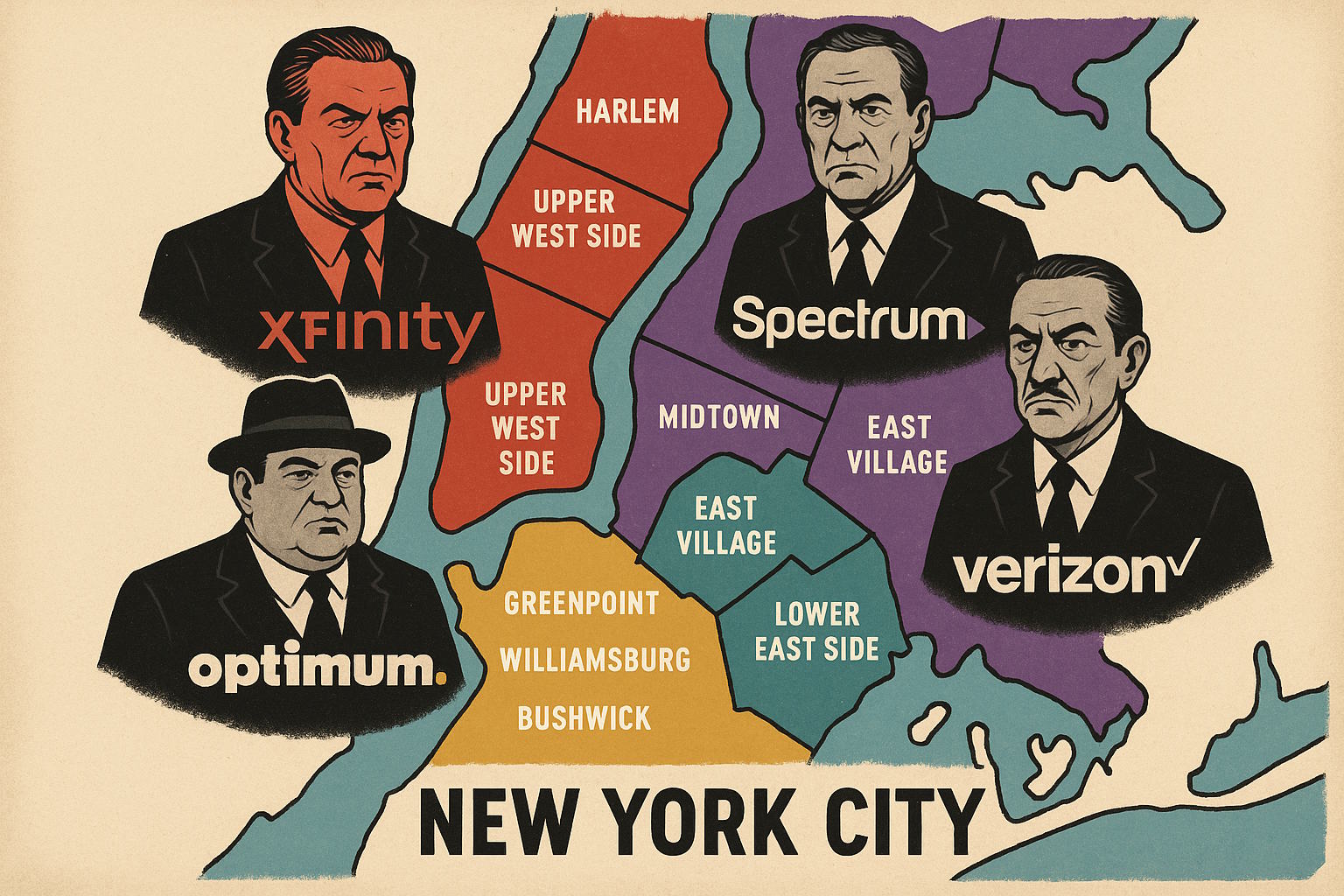
Why? The answer lies in a profound lack of competition. According to a **2020 report from the Institute for Local Self-Reliance**, nearly 83 million Americans live under a broadband monopoly, with millions more having only the choice between two providers. This market consolidation allows companies to raise prices with impunity. We went from a competitive landscape to a series of regional fiefdoms where ISPs act as feudal lords, demanding higher and higher tributes for a service that has become as essential as running water.
And Con Edison? Don’t get me started on Con Ed. Remember when the electricity bill was that thing you paid without really looking at it? You’d tear open the envelope, scribble a check for forty bucks, and forget about it. Now, opening that email is a genuine act of courage. My last bill for my decidedly un-luxurious one-bedroom in The Bronx was $287. I actually laughed, the kind of laugh that borders on a sob. It’s not just my old, whirring AC unit. The **U.S. Energy Information Administration** shows the national average price per kilowatt-hour has nearly doubled since 2004. For us? It’s a perfect storm of an aging grid, climate change, and the simple, brutal math of density. We’re being taxed for the crime of wanting light and a fan.
The Bodega Barometer: Your Breakfast is Taking You to the Cleaners
But nothing, and I mean nothing, makes this crisis more visceral than the weekly pilgrimage to the bodega or the Key Food. This is where the abstract becomes achingly concrete. The very staples of a simple, affordable breakfast—eggs, bread, milk, OJ—have become luxury items.
I used to do the “grab and go.” Now I do a slow, depressing calculus in the dairy aisle. The official data from the **U.S. Bureau of Labor Statistics** is just a confirmation of my receipt-induced trauma. The cost of food has shot up over 80% in the last two decades. But let’s get specific.
Remember the Great Egg Panic of 2022? When a carton of eggs cost more than a tribute band concert ticket? Sure, avian flu was the trigger, but it exposed a system with no slack left in it.
**Eggs:** The price has been notoriously volatile, but the trend is sharply upward. A price spike in 2022-2023 saw increases of over 60% in a single year due to avian flu, but even accounting for that, the long-term trend is one of significant increase.
The price of cereal and bread has just… climbed. There’s no drama, no crisis, just a silent, steady suffocation. **Cereal and Bakery Products:** The BLS category shows a steady, unrelenting climb, up over 75% in the last 20 years. You don’t notice it week to week, but then you look back and realize a loaf of bread now costs what a full deli sandwich used to.
**Dairy:** A gallon of milk, once a symbol of mundane affordability, has followed suit, with prices doubling in many urban centers. While corporate consolidation in the food industry—where a handful of companies control the vast majority of our food supply—is a primary driver, a new and significant accelerant was thrown onto this fire in the last several years: the tariff wars.
The “Tariff Tax”: How a D.C. Trade War Became a Queens Problem
The political narrative from 2018 onward was one of economic nationalism and “winning.” But for New Yorkers staring at their receipts, the reality felt very different. The Trump administration’s sweeping tariffs on thousands of imported goods from China, the European Union, Canada, and Mexico were not paid by foreign countries, as was often claimed. They were a tax on American businesses and consumers.
And then, right as this slow burn was getting unbearable, Washington D.C. decided to pour gasoline on it. The Trump administration’s tariff wars were sold to us as a tough negotiation, a way to “win” against China and everyone else. But from my perspective, standing in the checkout line? It felt like a new, invisible tax.
The narrative was that “China will pay for it.” What a joke. A **landmark study from the National Bureau of Economic Research (NBER)** laid it out in brutal, academic terms: the entire cost of those tariffs was dumped directly into the laps of U.S. importers and, you guessed it, us—the consumers. The study estimated it was costing our economy $316 billion a year in lost efficiency. Another study from **The Tax Foundation** estimated that the tariffs would reduce long-run GDP by 0.21% and wages by 0.14% while eliminating 166,000 full-time equivalent jobs.
What does that mean in the aisles of a C-Town in Bushwick or Gristedes in Manhattan’s Upper East Side ? The aluminum tariff made my canned seltzer and tomatoes more expensive. The steel tariff made cars, washing machines, and the tools to build new apartments more expensive. It created a ripple effect of pain. A farmer in Nebraska pays more for a tractor part, which raises the cost of growing corn, which raises the cost of feeding chickens, which lands squarely in the price of the dozen eggs I’m holding, wondering if I can skip them this week. It was economic arson, and our wallets were what burned.
The Four-Figure Shakedown: A Home is Now a Luxury Item
If utility and grocery bills are the paper cuts, rent is the gaping wound. And through it all, the granddaddy of them all, the king of the monthly panic attack: rent. The New York City rental market isn’t a market; it’s a blood sport. The **NYU Furman Center** reports that from 2000 to 2021, median gross rent in New York City increased by over 30% in real terms (adjusted for inflation), while the median income for renters stagnated. In neighborhoods that saw rapid gentrification, the increases were catastrophic for long-term residents.
But let’s translate that from data to despair. That “affordable” one-bedroom you found in a decent, non-luxury (read: old) building in Sunnyside? $2,800. And that’s a *find*. To afford that without being officially “rent-burdened,” you need to be pulling in over $110,000 a year. The **U.S. Census Bureau** quietly whispers that the median household income here is far, far below that. So what are millions of us doing? We’re making the impossible choice. Do I pay the rent, or do I pay my student loans? Do I buy groceries, or do I save for a Con Ed bill that’s going to be astronomical next month? This is the “affordable” New York life. It’s a high-wire act with no safety net.
This is the environment we live in. A city where the baseline for survival has been systematically ratcheted up, year after year, by forces that feel distant and unaccountable: monopolistic corporations, speculative real estate investors, and federal trade policies that treat everyday Americans as collateral damage.
The Mamdani Moment: When Our Panic Found a Voice – Politics of the Pocketbook.
For years, the political establishment offered technocratic solutions and incrementalism. The political response was a shoulder shrug or a promise to “study the issue.” It was maddening. We were drowning in plain sight, and they were offering us a life raft made of paperwork. The constant financial anxiety created a powerful, simmering demand for a politics that spoke directly to the material reality of people’s lives. This is the soil in which the political movement of Zohran Mamdani took root and flourished. He wasn’t a career politician; he was a housing counselor. He didn’t just *acknowledge* the squeeze; he narrated it back to us in perfect, furious detail. His campaign wasn’t built on vibes; it was built on a declaration of economic war on our behalf. He championed **social housing**—not as a niche idea, but as a core necessity. He talked about a **publicly owned internet utility**, pointing to cities like Chattanooga that built their own and offered gigabit speeds for a fraction of our cost. “Why are we paying a monopoly for the privilege of being connected?” he’d ask, his voice cutting through the usual political fog. “Why are we letting corporate landlords treat our homes like a speculative casino?”
His enthusiasm was infectious because it was authentic. He spoke with the knowledge of someone who had personally seen the eviction notices and the shut-off threats. He framed affordability not as a personal failing but as a political choice. “Why are we paying a monopoly for the privilege of being connected?” he would ask at rallies. “Why are we allowing corporate landlords to treat our city as a speculative casino while families sleep in shelters?”
This message resonated because it was validated by the lived experience of millions. Third-party research became a powerful weapon in his arsenal. He would cite **Reports from the Community Service Society of New York** showing the disproportionate rent burden on Black and Latino households. He would point to **data from the Economic Policy Institute** demonstrating how wage stagnation for the bottom 90% of earners had decoupled productivity from prosperity.
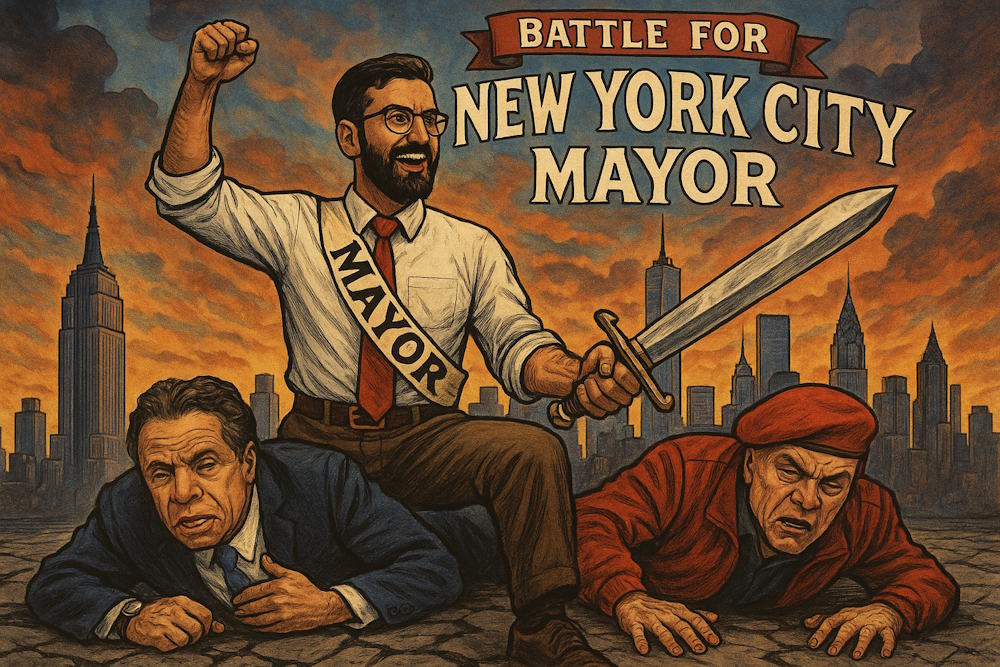
He didn’t win despite focusing on these “kitchen-table” issues; he won *because* of it. In a crowded field, his unwavering, knowledgeable, and enthusiastic focus on the core economic pressures facing New Yorkers cut through the noise. He presented himself not just as a politician, but as a thought leader for a new economic vision for the city—one where the market served the people, not the other way around. His victory was a testament to a simple, powerful idea: when people are drowning in costs, the most popular life raft is a plan to make life affordable again.
This wasn’t just rhetoric; it was validation. He weaponized our reality by backing it up with the data we all felt. He’d stand in a community center in the Bronx and cite a **Community Service Society report** on rent burden like he was revealing the enemy’s playbook. He’d use **Economic Policy Institute** stats on wage stagnation to show us it wasn’t our fault. He was a thought leader, yes, but more importantly, he was a translator, turning our collective anxiety into a coherent, powerful political program. He won because he was the first one who looked us in the eye and said, “You’re right to be angry. Now, let’s go do something about it.”
The Road Ahead: The Fight for the Soul of the City
The New York story is just America, with the volume turned all the way up. The last twenty years have been a masterclass in dismantling affordability, a project of corporate consolidation and policy choices that started long before the tariff wars but were supercharged by them. The Trump-era tariff wars were a dramatic escalation, but they were an accelerant on a fire that was already well-fueled by decades of deregulation, corporate consolidation, and policy choices that prioritized wealth over work.
Mamdani’s victory is a bellwether. It’s a signal that we’re done with the politics of the past. We’re not voting on nostalgia or fear. We’re voting on the arithmetic of our own lives. The hum of financial anxiety in this city has become a roar, a demand for a government that fights to lower our cost of living, not just manage our decline.
The fight for affordability isn’t just another issue. It’s the fight for the soul of this city. It’s the question of whether New York—and by extension, America—is a place for people who work, who create, who live, or just a playground for the already-rich. For the first time in a long time, thanks to a movement that started in our kitchens and our bank statements, it’s a fight we’re starting to believe we can win. And it’s about damn time.
Research Citation & Sources:
### Government & Statistical Data
1. **U.S. Energy Information Administration (EIA) – Electricity Data**
* **What it supports:** The national trend of rising electricity prices.
* **Link:** [https://www.eia.gov/electricity/data.php]
2. **U.S. Bureau of Labor Statistics (BLS) – Consumer Price Index (CPI)**
* **What it supports:** The data on the long-term rise in the cost of food, cereal, bakery products, dairy, and eggs.
* **Link:** [https://www.bls.gov/cpi/]
* *Note: The BLS CPI Data Tools allow you to create custom tables tracking specific product categories (e.g., “Cereals and Bakery Products,” “Dairy and Related Products”) from 2000 to the present.*
3. **U.S. Census Bureau – American Community Survey (ACS)**
* **What it supports:** Data on median household income in New York City, which is crucial for illustrating the rent burden.
* **Link:** [https://www.census.gov/programs-surveys/acs]
* *Note: You can use data.census.gov to search for median household income for New York City and compare it to the income required to afford median rent.*
### Academic & Economic Research
4. **National Bureau of Economic Research (NBER) – “The Return to Protectionism”**
* **What it supports:** The finding that the cost of the Trump-era tariffs was borne almost entirely by U.S. importers and consumers, not by foreign countries.
* **Link:** [https://www.nber.org/papers/w25638]
* *Note: This is the seminal paper by Mary Amiti, Stephen J. Redding, and David E. Weinstein. The link may be behind a paywall, but numerous news outlets (like Vox, The Wall Street Journal) have summarized its findings.*
5. **The Tax Foundation – “Tracking the Economic Impact of U.S. Tariffs and Retaliatory Actions”**
* **What it supports:** The estimates that tariffs would reduce long-run GDP, wages, and eliminate jobs.
* **Link:** [https://taxfoundation.org/tariffs-trump-trade-war/]
6. **Institute for Local Self-Reliance (ILSR) – Broadband Monopoly Report**
* **What it supports:** The statistic that 83 million Americans live under a broadband monopoly.
* **Link:** [https://ilsr.org/report-monopoly-america-internet-choice/]
### Policy & Advocacy Research
7. **NYU Furman Center – State of New York City’s Housing and Neighborhoods**
* **What it supports:** The data on rising median gross rent in NYC over the last two decades compared to stagnant renter incomes.
* **Link:** [https://furmancenter.org/sotc]
* *Note: Their annual “State of the City” reports are a goldmine for housing data. You can find year-over-year and long-term trend data on rents, income, and affordability.*
8. **Community Service Society (CSS) of New York – Unheard Third Survey**
* **What it supports:** Reports on the disproportionate rent burden faced by low-income, Black, and Latino households in NYC.
* **Link:** [https://www.cssny.org/news/entry/the-unheard-third]
* *Note: CSS publishes an annual “Unheard Third” survey that is one of the most cited sources on hardship and inequality in the city.*
9. **Economic Policy Institute (EPI) – Wage Stagnation Data**
* **What it supports:** The analysis demonstrating how wage growth for the bottom 90% of earners has decoupled from productivity and overall economic growth.
* **Link:** [https://www.epi.org/nominal-wage-tracker/]
* *Note: EPI has numerous charts and publications on this topic. The “Nominal Wage Tracker” is a clear, visual tool showing the gap between actual wages and what they could be.*
### Real-World Example
10. **Chattanooga’s EPB Fiber Optics**
* **What it supports:** The successful model of a publicly owned internet utility providing high-speed, affordable service.
* **Link:** [https://epb.com/]
* *Note: The website itself serves as proof of the service and its offerings, which are often cited in policy debates about municipal broadband.*